

Which Bills Accept Instant Posting in Jamaica?
When a due date is close, the question is not simply whether you can make a payment. It is which bills accept instant posting, so the payment reflects on the biller's system without an unnecessary wait. For households, busy professionals, and Jamaicans overseas supporting family, that difference can mean avoiding a service interruption, reconnection fee, or stressful call to customer care.
Instant posting is especially valuable for essential services. It gives you a clearer picture of whether your account has been credited after payment, rather than leaving you to wonder whether a receipt will take hours or days to be processed. Still, instant posting does not mean every biller or every account type updates at the same speed. Knowing the supported billers and checking your receipt are the practical steps that protect your account.
Which Bills Accept Instant Posting?
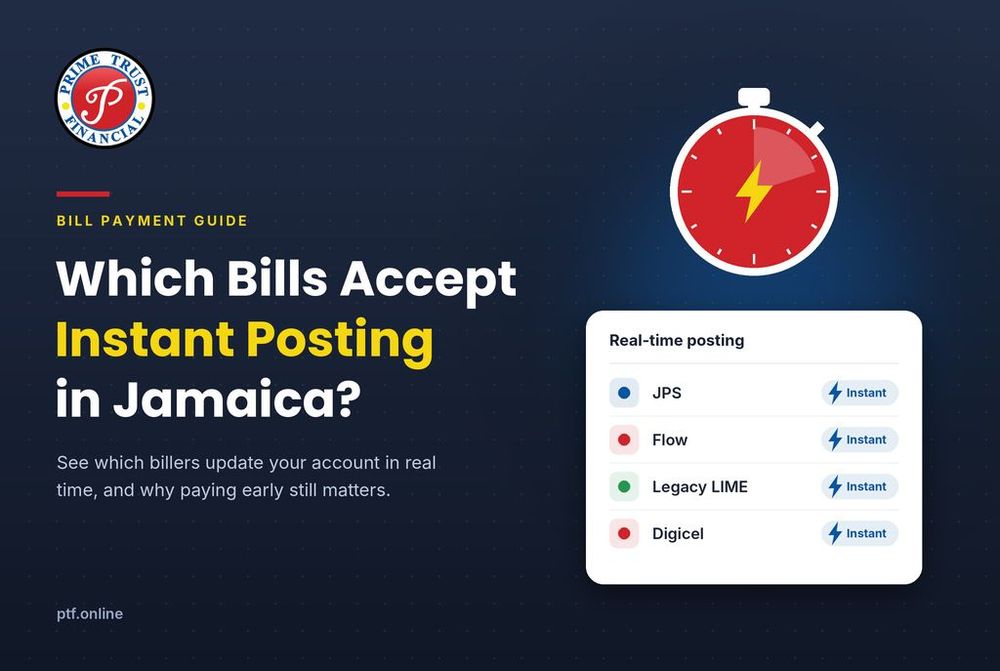
At Prime Trust Financial, payments made to JPS, Flow, legacy LIME accounts, and Digicel reflect in real time. These are among the bills many Jamaican households manage regularly, which makes immediate confirmation useful when payment timing matters.
For a JPS account, real-time reflection helps when you are paying near the due date or restoring an account after a balance has fallen behind. For Flow and legacy LIME accounts, it gives customers greater confidence that their internet, cable, or phone payment has been received. Digicel customers can also benefit from a payment that updates without the typical uncertainty of a delayed posting cycle.
Real-time reflection refers to the payment appearing on the biller's system promptly after the transaction is completed. It does not change your balance before you pay, remove an existing late fee, or override a disconnection process that may already be underway. If your account is at risk of interruption, pay as early as possible and retain proof of payment.
Why Instant Posting Matters More Than a Receipt
A receipt confirms that a payment transaction was completed through the payment provider. Posting confirms that the biller has applied that payment to your account. In many cases, those events occur close together, but they are not always the same thing.
That distinction matters most when your bill is overdue, your service has been restricted, or someone needs confirmation before the end of the day. A payment channel can be legitimate and secure while still having a processing window before the biller updates the account. Instant posting reduces that window for supported services.
It also helps families coordinating payments from different locations. A person abroad may cover a utility or phone bill for a relative in Jamaica and want assurance that the account is current. A faster posting result makes it easier to communicate clearly: the payment was made, the account was updated, and the next step, if any, can be handled sooner.
Check the Bill Type Before You Pay
The company name alone is not always enough to determine how a payment will post. Some billers have different account categories, legacy account numbers, prepaid services, or separate business and residential arrangements. Entering the wrong customer number can delay resolution even if the payment channel supports real-time posting.
Before confirming a payment, compare the account number on the bill with the number you enter. Review the customer name and amount when those details appear on the payment screen. If you are paying for someone else, ask for a recent bill rather than relying on an old account number saved in a message.
You should also consider the current status of the account. A standard monthly payment and a payment made after disconnection may follow different operational processes. Instant posting can show the payment quickly, but physical reconnection, account review, or the removal of a restriction may still require additional time from the biller.
Pay Before the Final Hour When Possible
Instant posting is a practical option, not a reason to wait until the last minute. Billers may have cut-off times, overnight system maintenance, or account actions already scheduled. Paying a day or two before the deadline gives you time to correct an account-number error or address an issue with the bill amount.
The same advice applies to customers paying from overseas. Allow time for any card authorization, currency conversion, or identity verification required by the payment method. Once the transaction is complete, save the reference number and send it to the account holder if they may need it.
What to Do After an Instant-Posting Payment
After paying a supported bill, review the confirmation details immediately. Keep the receipt or transaction reference until you can see that the balance has updated as expected. For an account close to disconnection, that record is especially useful if you need to contact the biller.
If the account does not reflect the payment right away, avoid making a second payment immediately. First, check that the account number and biller selection were correct, then review your transaction receipt. Duplicate payments can create a credit balance that may take time to sort out.
Contact the payment provider or biller with the transaction reference, payment date, amount, and account number if assistance is needed. Clear details make it easier for customer support to trace the transaction. If the account has a service restriction, ask the biller whether any separate reconnection step or outstanding charge remains.
Instant Posting Does Not Mean Every Bill Is Instant
Customers often use the phrase “instant posting” to describe any quick payment. In practice, posting speed depends on the agreement and technical connection between the biller and the payment service. Some billers may post on the same day, on the next business day, or after a scheduled batch update.
That is why it is better to verify the posting expectation before you pay a time-sensitive bill. If a merchant, school, insurer, landlord, or government agency accepts payments through a collection point, ask whether its system updates in real time or whether you should allow processing time. The answer may also vary by payment channel.
For regular monthly expenses, build your schedule around the slowest posting time, not the fastest one. Utility, telecom, and other essential bills are easier to manage when you pay before the due date and treat immediate reflection as added assurance rather than your only plan.
A Practical Payment Routine for Families and Small Businesses
A simple routine can prevent most payment surprises. Keep current account numbers in one secure place, but confirm them against each new statement. Record due dates for JPS, Flow, legacy LIME, and Digicel services, then set a reminder several days ahead of each deadline.
For a small business, assign one person to make payments and another to review the confirmation when amounts are significant. This basic separation reduces duplicate payments and missed balances. For families receiving support from abroad, agree on who will share the bill, who will make the payment, and who will confirm that the account is updated.
When you use a service with real-time reflection, you gain useful visibility at a moment when timing matters. Pair that speed with accurate account information, an early payment habit, and saved receipts. The result is less uncertainty and more control over the bills that keep daily life and business moving.